Good afternoon everyone!
Our fall e-newsletter - the Drive Thru Edition - is now available for viewing at http://stonyvalley.com/Fall2015-Vol3No4.pdf. It lists some exciting upcoming events as well. Our program last night at the East Hanover Township Historical Society in Grantville had a wonderful turnout and we hope to see some of you out at our program at Sweet Arrow Lake County Park in Pine Grove tonight as well. Remember this Sunday is Drive Thru from 9 am to 3 pm, with more details inside the newsletter, and if all goes well we'll also have a Spook Hike this Halloween too! (Please make sure to check back for potential cancellation notices for these two weather dependent events.)
We hope you enjoy this newsletter, although it may be getting to you a little late, and HAPPY EXPLORING!
Brandy M. Watts Martin
Schuylkill & Susquehanna Railroad Historian
Tuesday, October 13, 2015

Monday, March 30, 2015
The Mysterious "Mr. Youse" - Part 2
(or Thriving on Fresh Air and Wood Rats)
My previous post revealed the identity of "Mr. Youse" as Walter L. Hughes, of Trenton, NJ, who moved to Pennsylvania in November 1916 to assist Mulford Foster with farm work and other projects on his Cold Spring Nature Farm. Walter's main objective was to establish an outdoor school for boys. Despite all we initially learned about Walter's six-month stay at Cold Spring, some aspects of his life remained a mystery, and additional research and communications with Walter's family were undertaken to try to answer certain questions. It turns out we may never have any definitive answers, but we can make some inferences based on the records we found and information and insights provided by one of Walter's granddaughters.
Where did Walter Hughes reside while living at Cold Spring? And were his wife and son with him?
Mulford Foster lived with his wife, Fridel, and daughter, Gerda, in the corner house at Cold Spring. At times during the six months from November 1916 to June 1917, the Fosters had extended house guests, including Fridel's father and stepmother, and Mulford's older brother and his wife. Would there have been room with them for Walter and his family? At this time also, according to personal letters, the farmhouse at Cold Spring needed considerable improvements to make it habitable. Would they have stayed there?
Another possibility is that Walter and his family resided in the nearby Ney farmhouse over Second Mountain, Mulford having purchased Joseph Ney's home and property in October 1916, the month before Walter's arrival. The Ney property, just over 211 acres, lay in both East Hanover and Union Townships, straddling the Cold Spring Road on the south side of Second Mountain (see map below). One newspaper article says Walter lived "near Lotell" (aka Cold Spring). The same article, however, also states: "Circumstances make it necessary that they be outdoors most of the time, excepting nights..." - which could support the crowded house hypothesis - or simply mean most of their daily work was done outdoors.
Whether or not Walter Hughes' wife of two years and their year old son ever lived at Cold Spring is unknown. We could find neither mentioned in any newspaper articles as being at Cold Spring except for the snippet about their visit, with Walter, to Cold Spring at the end of summer in 1916, a month or two before Walter moved there. Yet, the photograph of Walter and his son at the springhouse (see previous post) appears to have been taken in the Fall or Spring, the trees being without leaves, suggesting that his wife and son either lived at Cold Spring or at least visited Walter there. We can only conjecture about the reasons Walter's wife and son may not have lived with him at Cold Spring.
A Trenton Evening Times article dated January 29, 1917, does reveal that another member of Walter's family, his younger brother Harvey, did indeed live for awhile at Cold Spring. The article states that Harvey, who was about twelve years old, "had taken up his abode" with Walter and enjoyed living "in the wilds of Pennsylvania," as this excerpt relates:
Why did Walter Hughes leave Cold Spring? And where did he go?
The most likely answer to the first question was found by Walter's granddaughter on a civil service application from the 1930's, which also held the answer to the second question. Under past employment was recorded: July 1911-November 1916, YMCA Central Branch, Trenton, NJ, Boys Work Secretary, annual salary $1080; November 1916-May 1917, Cold Spring Nature Farm, Lotell, PA, Naturalist Assistant, no salary, immediate supervisor M. B. Foster; May 1917-May 1919, Community YMCA, Rock Hill, SC, Community Secretary, annual salary $1800 (followed by succeeding jobs). It seems that Walter left Cold Spring to accept paid employment, or at least that was a determining factor, especially with a family to support. That no salary was listed for his position at Cold Spring didn't surprise us, since our research shows that financial constraints came with the life Mulford Foster chose to pursue at Cold Spring. Mulford was involved with many ventures but none provided a steady income, perhaps one of the main reasons he eventually left Cold Spring, too.
Walter's granddaughter describes him as "a man of deep convictions who [seemed to] change positions as much as a matter of principle as of opportunity." Dedicated to education and devoted to the public good, Walter spent much of his life working for various YMCAs. He also engaged in farming. He finished his career with fifteen years at the Franklin Institute in Boston, first as a chemistry and mathematics teacher and then as a supervisor of admissions and placement.
My previous post revealed the identity of "Mr. Youse" as Walter L. Hughes, of Trenton, NJ, who moved to Pennsylvania in November 1916 to assist Mulford Foster with farm work and other projects on his Cold Spring Nature Farm. Walter's main objective was to establish an outdoor school for boys. Despite all we initially learned about Walter's six-month stay at Cold Spring, some aspects of his life remained a mystery, and additional research and communications with Walter's family were undertaken to try to answer certain questions. It turns out we may never have any definitive answers, but we can make some inferences based on the records we found and information and insights provided by one of Walter's granddaughters.
Where did Walter Hughes reside while living at Cold Spring? And were his wife and son with him?
 |
| Foster Family Home at Cold Spring in 1916 (Photo courtesy of Herbert Barr) |
Mulford Foster lived with his wife, Fridel, and daughter, Gerda, in the corner house at Cold Spring. At times during the six months from November 1916 to June 1917, the Fosters had extended house guests, including Fridel's father and stepmother, and Mulford's older brother and his wife. Would there have been room with them for Walter and his family? At this time also, according to personal letters, the farmhouse at Cold Spring needed considerable improvements to make it habitable. Would they have stayed there?
Another possibility is that Walter and his family resided in the nearby Ney farmhouse over Second Mountain, Mulford having purchased Joseph Ney's home and property in October 1916, the month before Walter's arrival. The Ney property, just over 211 acres, lay in both East Hanover and Union Townships, straddling the Cold Spring Road on the south side of Second Mountain (see map below). One newspaper article says Walter lived "near Lotell" (aka Cold Spring). The same article, however, also states: "Circumstances make it necessary that they be outdoors most of the time, excepting nights..." - which could support the crowded house hypothesis - or simply mean most of their daily work was done outdoors.
 |
| A portion of F. W. Beers' 1875 County Atlas of Lebanon, Pennsylvania, showing the location of Joseph Ney's property (marked "J. D. Nye"), with information in red added by author |
Whether or not Walter Hughes' wife of two years and their year old son ever lived at Cold Spring is unknown. We could find neither mentioned in any newspaper articles as being at Cold Spring except for the snippet about their visit, with Walter, to Cold Spring at the end of summer in 1916, a month or two before Walter moved there. Yet, the photograph of Walter and his son at the springhouse (see previous post) appears to have been taken in the Fall or Spring, the trees being without leaves, suggesting that his wife and son either lived at Cold Spring or at least visited Walter there. We can only conjecture about the reasons Walter's wife and son may not have lived with him at Cold Spring.
A Trenton Evening Times article dated January 29, 1917, does reveal that another member of Walter's family, his younger brother Harvey, did indeed live for awhile at Cold Spring. The article states that Harvey, who was about twelve years old, "had taken up his abode" with Walter and enjoyed living "in the wilds of Pennsylvania," as this excerpt relates:
 |
| Foxes are fun to catch, but wood rats make a fine dinner! |
"In letters received by friends of the Hughes boys here [in Trenton, NJ], they relate some experiences. Outdoor life, they say, is having its effects upon them physically. Skating and coasting is a pleasure during all of the winter months...and they have learned to follow the snowy trails of the mountains in real mountaineer fashion.
Harvey has gone in for all kinds of trapping, the fox seen in the accompanying picture being an example of one of his catches. Wood rats are in the section in great numbers and the young trapper has learned the ins and outs of cornering that species. All kinds of trapping proves profitable, but the catching of rats is doubly profitable for the Hughes boys say they eat them, and they aver a rat dinner surpasses most any other dish and is not excelled by venison."
Why did Walter Hughes leave Cold Spring? And where did he go?
The most likely answer to the first question was found by Walter's granddaughter on a civil service application from the 1930's, which also held the answer to the second question. Under past employment was recorded: July 1911-November 1916, YMCA Central Branch, Trenton, NJ, Boys Work Secretary, annual salary $1080; November 1916-May 1917, Cold Spring Nature Farm, Lotell, PA, Naturalist Assistant, no salary, immediate supervisor M. B. Foster; May 1917-May 1919, Community YMCA, Rock Hill, SC, Community Secretary, annual salary $1800 (followed by succeeding jobs). It seems that Walter left Cold Spring to accept paid employment, or at least that was a determining factor, especially with a family to support. That no salary was listed for his position at Cold Spring didn't surprise us, since our research shows that financial constraints came with the life Mulford Foster chose to pursue at Cold Spring. Mulford was involved with many ventures but none provided a steady income, perhaps one of the main reasons he eventually left Cold Spring, too.
Walter's granddaughter describes him as "a man of deep convictions who [seemed to] change positions as much as a matter of principle as of opportunity." Dedicated to education and devoted to the public good, Walter spent much of his life working for various YMCAs. He also engaged in farming. He finished his career with fifteen years at the Franklin Institute in Boston, first as a chemistry and mathematics teacher and then as a supervisor of admissions and placement.
Monday, February 2, 2015
The Mysterious "Mr. Youse" - Part 1
A number of years ago we came across a few brief mentions in local Lebanon newspapers, from the year 1916, about a "Mr. Youse, of Trenton" visiting, moving to, and working at Cold Spring. These vague snippets provided very little information about "Mr. Youse" and his activities at Cold Spring. Searching for a man named Youse in New Jersey censuses, Trenton city directories, and other records, yielded nothing pertinent. It was as if the man never existed. Frustrated by the many dead ends, we added "Mr. Youse" to our "To Follow Up" folder and busied ourselves with more productive leads to uncovering the history of Cold Spring.
Details on who "Mr. Youse" was and what he was doing at Cold Spring eluded us - until a woman living in Washington State emailed us a Trenton (NJ) newspaper article, from 1916, headlined "Walter L. Hughes to Live in 'Wilds'." The "wilds" were identified as Lotell, Lebanon County, Pennsylvania, or, in other words, Cold Spring, its post office at the time being named Lotell. What followed was a description of the projects Mr. Hughes intended to pursue as a partner with Mulford Foster, then owner of the Cold Spring Nature Farm at Cold Spring.
A sudden revelation hit us - aha! NOT Mr. Youse, but Mr. Hughes! No wonder we could find nothing about this person! Knowing his true identity and having the detailed article from the West Coast, our subsequent research quickly revealed much about "Mr. Youse" and his reason for being at Cold Spring.
 |
| Walter L. Hughes (Trenton Evening Times, NJ, November 6, 1916) |
All of this seems to have made Walter Hughes a suitable partner for Mulford Foster, a self-taught naturalist who for many years was also involved with the YMCA and the Boy Scouts, at various locations, giving nature talks and as camp naturalist. Mulford was caretaker of the Camden (NJ) YMCA's Camp Ayer, at Cold Spring, for a few years, before purchasing the property in January 1916. He hosted summer camps there for other boys' groups when not in use by the Camden YMCA.
Certainly their shared interests must have brought Walter and Mulford together. Mulford lectured in the public schools of Trenton during the winter of 1912, likely including the school Walter's younger brother Harvey attended, perhaps how they first met each other. Possibly Mulford's brother, Hubert, was a catalyst in some way since he was residing in Trenton at the time and a YMCA supporter. We do know the two men interacted at the Trenton YMCA's 1914 summer camp, Camp Washington, on Marshall's Island in the Delaware River, near Frenchtown, NJ. Walter was director of the camp and Mulford was camp naturalist. During July 1916, Walter again was in charge of the Trenton YMCA's summer camp, and the following month was head of the commissary and equipment departments of the Boy Scout summer camp on the same island. A Lebanon newspaper mentions Mulford spent three weeks in August at Camp Washington; no doubt he was there as camp naturalist.
After the New Jersey scout camp closed that summer, Walter, his wife and young son, visited Cold Spring for an indeterminate length of time. He resigned his position as Boys' Secretary in October and moved to Cold Spring in early November. In the "wilds" of Pennsylvania, Walter planned to assist Mulford in a number of projects - developing an extensive chicken and pigeon business, planting a large apple orchard, and bottling spring water - along with general farming.
Walter's primary goal, however, was to establish "an all-year camp or rather out-of-doors school for boys," in which he would be an instructor. He felt that "to give a lad the opportunity afforded by practical study in the open would tend to make of the youth a perfectly developed man, physically, mentally and spiritually..." (Trenton Evening Times, Nov 6, 1916). He felt assured that his venture would be highly successful, but things don't always work out as planned.
To what extent Walter and Mulford worked on their intended projects is unknown. Little news came out of Cold Spring in the winter months. They planned to clear forty acres of land for the apple orchard to be planted in the spring. Apparently, they did so, for it was reported that 150 apple trees were planted the first week of May 1917. Shortly afterwards, Walter visited South Carolina for a few weeks. Then we could find no further mentions in the Lebanon newspapers of Walter Hughes at Cold Spring.
Our newfound information about "Mr. Youse" had enlightened us, but some mystery still remained in unanswered questions such as: Why did Walter leave Cold Spring? Where did he go? Where did he reside during his six months at Cold Spring? Were his wife and son living with him? Neither were ever mentioned except for their visit to Cold Spring at the end of summer in 1916.
More research was needed. And we thought perhaps if we could locate a living relative of Walter Hughes, they could provide us with some answers. We tracked down Walter Hughes' two granddaughters, who live on the East Coast. Both were interested in and appreciative of the information we had dug up about their grandfather, it being from a time period of which they knew little about his life. Having aroused their curiosity and wanting to help us with our research, the one granddaughter offered to look through "a sizeable trove" of inherited family photographs and mementos for anything pertaining to Lotell (Cold Spring). Since their grandfather had only spent six months at Cold Spring, finding anything seemed a long shot.
A week or so later, this photo arrived by email:
 |
| "Lotell, Spring House, Walt & Pete" (words written on back of above photo of the Cold Spring, circa 1916) Walter Hughes, at left, and his young son Walter Jr., nicknamed "Pete" because he was as curious as Peter Rabbit (Photo courtesy of Judith Hughes) |
 |
| Cold Spring & a small shed below it, circa early 1920's (Photo courtesy of Francis Ditzler) |
As for the unanswered questions about Walter Hughes, I'll share what we learned in my next blog post, The Mysterious "Mr. Youse" - Part 2 (or Thriving on Fresh Air and Wood Rats).
Thursday, October 30, 2014
What's On the Menu at Cold Spring?
For years we could only speculate about the culinary
delights served to visitors and guests at the Cold Spring Hotel. Newspapers prior to 1881 give few particulars
about the hotel table. But after the
second hotel building was constructed adjacent to the old hotel and other
improvements made, many news articles attest to the Cold Spring Hotel’s fine
reputation for its cuisine. Correspondents
who dined at the hotel noted: “excellent
cuisine” (1881); “the bill of fare included everything palatable and healthful,
and the beauty of it is that the supper was but a specimen of the every-day
cuisine of the hotel” (1884); “the table [is] abundantly supplied with a
variety of well cooked and well served viands” (1888); “the table is all that
any person might wish for” (1888); “the table is bountifully supplied with
appetizingly cooked food” (1891); “the cuisine cannot be excelled” (1891); and
more. High praises - but what particular foods
and dishes did the patrons actually eat?
According to an 1888 Harrisburg Telegraph article: "The table will be abundantly supplied with fresh meats and vegetables, daily, from Harrisburg markets, also from the farm connected with the park, which also furnishes fresh milk, cream, butter, eggs, etc." Circulars from the 1890's advertising the Cold Spring Resort similarly state: "The Table is supplied with the best of everything in season. Our own farm, connected with the Park, furnishes fresh milk, cream, eggs, poultry, etc. The best creamery butter will be constantly supplied for table use." In the 1880's and 1890's the farm at Cold Spring included a stable, a chicken house, a pig sty, apple and peach orchards, a vineyard, grain fields and vegetable gardens, all of which would have supplied food for the hotel table. Other food supplies, such as flour and cornmeal from the mill at Lickdale, were reportedly brought by wagon over Second Mountain. This information reveals some of the staple foodstuffs the hotel cooks had to work with - but what specific dishes did they prepare for visitors and guests?
According to an 1888 Harrisburg Telegraph article: "The table will be abundantly supplied with fresh meats and vegetables, daily, from Harrisburg markets, also from the farm connected with the park, which also furnishes fresh milk, cream, butter, eggs, etc." Circulars from the 1890's advertising the Cold Spring Resort similarly state: "The Table is supplied with the best of everything in season. Our own farm, connected with the Park, furnishes fresh milk, cream, eggs, poultry, etc. The best creamery butter will be constantly supplied for table use." In the 1880's and 1890's the farm at Cold Spring included a stable, a chicken house, a pig sty, apple and peach orchards, a vineyard, grain fields and vegetable gardens, all of which would have supplied food for the hotel table. Other food supplies, such as flour and cornmeal from the mill at Lickdale, were reportedly brought by wagon over Second Mountain. This information reveals some of the staple foodstuffs the hotel cooks had to work with - but what specific dishes did they prepare for visitors and guests?
We pondered over possible menu items based on the aforementioned information and culinary dishes suggested by menus from the 1880’s and 1890’s from similarly classed hotels in Harrisburg,
Lebanon and Reading, some of which were owned and operated at times by the
various owners and managers of the Cold Spring Hotel. Then we came across the following 1892 ad:
 |
| Ad stating "Chickens and Waffles will be served" Reading Times - May 9, 1892 |
Also we found a Reading Times article describing the annual
Fall outing of the Reading Press Club in 1897, a train excursion to various
points of interest, including a stop at Cold Spring where the newspapermen and
their families enjoyed a dinner of “chickens and waffles and all the desirable
concomitants prepared with a lavish hand.”
By its numerous mentions in social news of the time, chickens and waffles
was a popular dish served at banquets and large gatherings. And it was served more than once at the Cold Spring Hotel.
After years of contemplating about the culinary
delights served to visitors and guests at the Cold Spring Hotel, imagine our excitement when recently we
came across a news story describing the Schuylkill County Bar Association’s
annual dinner excursion, to Cold Spring, in July 1888. Included was the following detailed menu for the
“elegant dinner” they enjoyed:
 |
| Cold Spring Hotel Dinner Excursion Menu as printed in the Harrisburg Telegraph - July 20, 1888 |
If anyone has additional information on foods served at the Cold Spring Hotel, or a hotel menu, or knows the names of persons who worked in the hotel kitchens or dining rooms (or was employed in any other job at Cold Spring), we'd appreciate hearing from you. Post a comment or contact us at email.
Monday, September 29, 2014
Fall 2014 Upcoming Events and E-Newsletter

We hope to see you at one of our upcoming events. Brandy M. Watts Martin, Schuylkill & Susquehanna Railroad Historian and Seth A. Martin, Stony Valley Daily Life Researcher, had a wonderful time at the Stony Creek Valley Coalition's Annual Picnic this past weekend at the Kittatinny Rod and Gun Club, where they showed the 3-D model and were on hand to answer questions. If you missed the 3-D model this past weekend, don't worry. What is usually Drive Thru weekend in October (Drive Thru is unfortunately cancelled this year) will see the 3-D model at Comics and Paperbacks Plus in Palmyra. Check out the second page of the newsletter for ALL the upcoming events we have scheduled. Fall is the season for presentations and events for StonyValley.com!
This issue and back issues of the e-newsletter can be found at http://www.stonyvalley.com/e-newsletters.html, and if you want to make sure you don't miss any updates on the blog or an issue of the e-newsletter, please sign up for our e-mail list!
Monday, September 8, 2014
Waltonians Feed Wild Ducks
The other day I was looking through a stack of old bulletins
of the Lebanon County Chapter of the Izaak Walton League of America when I
dumb-lucked across an interesting historical tidbit having to do with Cold
Spring. The Izaak Walton League is a conservation organization composed of hunters, anglers, and outdoor enthusiasts whose motto (from the bulletins) is "Defender of Woods, Water and Wild Life." In the June 1946 bulletin, Marlan
J. Heller, Chairman of the Wildlife Conservation Committee, reported:
This information about the planting of duck food doubly interested us - because we study Cold Spring and because we live on Lake Strause. Actually, it triply interested us since some of my husband Jim’s relatives were actively involved with the Izaak Walton League at the time. (His grandfather, William T. Logan, was the first president of the Lebanon County Chapter when it was formed in February 1939). In the aforementioned bulletin, under "worthy activities" of the Izaak Walton League is listed: "Plant Duck Food - Wild Celery, Lilies, etc., in Strauss Dam and Cold Spring Dam." Unfortunately, we could locate no local newspaper mentions of this project."The order recently placed with Terrell’s Aquatic Nurseries for wild duck food was received on Friday, April 26th. Since the wild celery winter buds and the white water lilies are perishable, they were prepared and planted as soon as possible. Half of the wild celery winter buds and the water lilies were planted at Camp Strauss in Monroe Valley on Saturday, April 27th, and the balance at Cold Spring’s on Sunday, April 28th. Since this Aquatic food program is a paid project, we urge all Sportsmen and the general public to refrain from picking or destroying these plants, thus helping to keep these places suitable for Wild Life propagation."
Terrell’s Aquatic Nurseries, located in Oshkosh, Wisconsin, were operated by Clyde B. Terrell, a nationally recognized authority on
waterfowl and their feeding habits and habitats. Wild celery is an underwater grass eaten by many species of diving ducks. Wood ducks and ring-necked ducks eat the seeds of water lilies. Submerged portions of aquatic plants also provide habitats for many invertebrates that are eaten by ducks and other wildlife. On his aquatic farm in Wisconsin, Clyde Terrell grew and gathered wild rice, wild
celery, and other foods to be distributed for planting in suitable localities
to attract ducks and other migratory waterfowl. Plants and seeds were shipped throughout the U.S. and Canada. Some of them ended up being planted at the Cold Spring Dam, possibly by Jim's grandfather and great grandfather.
 |
| 1932 Advertisement for Terrell's Aquatic Nurseries |
Does anyone remember ever seeing white water lilies on the lake at Cold Spring before the dam was washed away in 1972 by Hurricane Agnes? None of the old photographs we have show water lilies. Has anyone encountered wild ducks on the lake or Stony Creek? If anyone knows of other wildlife projects the Izaak Walton League participated in at Cold Spring, such as stocking fish, which they did in Lake Strause and many other dams and streams in Lebanon County, we'd like to hear from you. Post a comment or contact us at email.
Sunday, July 13, 2014
Historically Weedy
I
apologize for not writing an update regarding the Historic Garden sooner, but
it has been a crazy past few months, and it’s hard to think that summer is
already half over! We’ve had to compete with technology issues over the past
view months including having to purchase a new computer along with internet
issues. Life is just a little more
complicated now than it was in Rausch Gap in this regard. Back in Rausch Gap, I
could have just informed you of our progress in the garden when we passed each
other in the village, walking to work, or at the Company Store that would have
most likely served as the place to hear the news and happenings in town. Unfortunately this Historic Garden does come
with some modern inconveniences.

WHAT'S GROWING IN THE HISTORIC GARDEN
(other than weeds)
 Potatoes – Garnet Chile – As you saw from our earlier post we planted two
pounds of potatoes in three rows. They grew to about three foot tall and were
mounded up with dirt only once. We did have some Colorado Potato Beetles on
them at one point, but we removed all of them the old-fashioned way (picking
them off by hand). Please Note: Those in in Rausch Gap would NOT have had the
misfortune of dealing with the potato beetle due to the beetles not migrating
eastward from Colorado until 1859. The
residents of Rausch Gap would have been more worried about another potato
famine, than the beetle. Therefore we
have no true basis on how they got rid of them, other than likely hand-picking
them off and dropping them into a container of kerosene as children did around
the time of the Civil War. We now believe there is a blight attacking our
potatoes (in all of our gardens). Not
fun!
Potatoes – Garnet Chile – As you saw from our earlier post we planted two
pounds of potatoes in three rows. They grew to about three foot tall and were
mounded up with dirt only once. We did have some Colorado Potato Beetles on
them at one point, but we removed all of them the old-fashioned way (picking
them off by hand). Please Note: Those in in Rausch Gap would NOT have had the
misfortune of dealing with the potato beetle due to the beetles not migrating
eastward from Colorado until 1859. The
residents of Rausch Gap would have been more worried about another potato
famine, than the beetle. Therefore we
have no true basis on how they got rid of them, other than likely hand-picking
them off and dropping them into a container of kerosene as children did around
the time of the Civil War. We now believe there is a blight attacking our
potatoes (in all of our gardens). Not
fun!
 Beets – Early Blood Turnip- We planted beets in rows along with
parsnips, marked carefully with twigs, and have found a few of these root
vegetables growing among the weeds.
Beets – Early Blood Turnip- We planted beets in rows along with
parsnips, marked carefully with twigs, and have found a few of these root
vegetables growing among the weeds.
About our Beet Variety:
Beets are great for storing over winter. As the theme is with the majority of our plants, they must be able to be stored for several months as to provide the much need nutrition during the long winter months. The Early Blood Turnip dates back to early part of the 19th century. “Its name is due to the fact that when cooked, the beet exudes a thick juice, similar in consistency to blood. This rich texture was particularly well liked by colonial cooks, especially the Pennsylvania Dutch. (www.motherearthnews.com)”
 Parsnips – Hollow Crown - We didn't hold too many high hoops
for the sole reason that they require sand/loose soil to grow in. We have
anything but that. The townspeople in Rausch Gap would have faced the same
issue with rocks to contend with.
Currently, we cannot find a single parsnip.
Parsnips – Hollow Crown - We didn't hold too many high hoops
for the sole reason that they require sand/loose soil to grow in. We have
anything but that. The townspeople in Rausch Gap would have faced the same
issue with rocks to contend with.
Currently, we cannot find a single parsnip.
 Onions – Yellow Flat Dutch – So we started our onions inside a
little late. Since we wanted a variety that was of the time period the only
available way to purchase them was as seeds compared to seed sets (which are
just really small onions), which is the common method to plant onions now. We
planted them in wooden containers in our wood shed. Well the mice decided they
looked tasted after a long winter once they started sprouting up like spring
onions. So, no onions this season.
Onions – Yellow Flat Dutch – So we started our onions inside a
little late. Since we wanted a variety that was of the time period the only
available way to purchase them was as seeds compared to seed sets (which are
just really small onions), which is the common method to plant onions now. We
planted them in wooden containers in our wood shed. Well the mice decided they
looked tasted after a long winter once they started sprouting up like spring
onions. So, no onions this season.


As you may have guessed from the title, the Historic Garden is a bit
weedy. Sorry, that’s actually a bit of
an understatement: it’s VERY weedy! As you saw from my previous post we
transformed a very overgrown area into what we hoped to be our Historic Garden.
Well one thing we didn't account for in this experiment is the reoccurrence of
all the weeds (not the original weeds mind you). Many of our former weeds had already dropped their seeds all over the ground
last fall, and a lot of those seeds became weed seedlings, and have now turned
into big weeds, just like their parents!
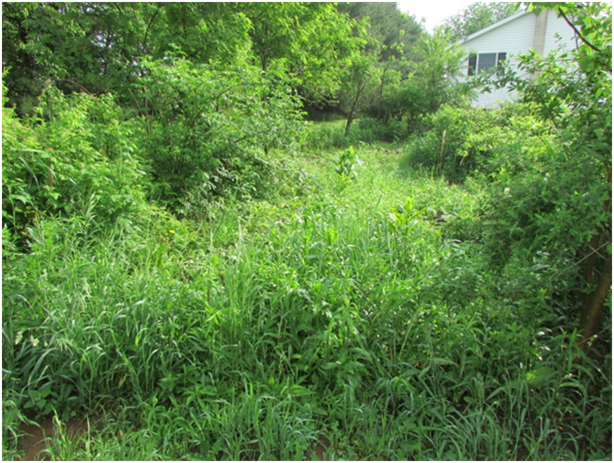
This picture of the Historic Garden
from late-May really makes us cringe with the amount of weeds all over the
place, but that’s one thing that separates us from those living in Rausch Gap:
we are not depending on the harvest from this
garden for survival, but rather THIS garden…
Ah, better! A view of approximately half of our main “modern”
garden at the end of June, which takes up the majority of our time, and like
those living in Rausch Gap, we depend upon the harvest of this garden to help
sustain us through the winter. The main
differences between us and those living in Rausch Gap with this particular
“modern” garden, other than modern varieties of vegetables, and nearly
unlimited garden space in the yard, is the modern convenience of rot-o-tillers,
weed whackers, metal plant stakes, sprinkler systems, and modern pest control
measures.
WHAT'S GROWING IN THE HISTORIC GARDEN
(other than weeds)
Potatoes – Garnet Chile – As you saw from our earlier post we planted two
pounds of potatoes in three rows. They grew to about three foot tall and were
mounded up with dirt only once. We did have some Colorado Potato Beetles on
them at one point, but we removed all of them the old-fashioned way (picking
them off by hand). Please Note: Those in in Rausch Gap would NOT have had the
misfortune of dealing with the potato beetle due to the beetles not migrating
eastward from Colorado until 1859. The
residents of Rausch Gap would have been more worried about another potato
famine, than the beetle. Therefore we
have no true basis on how they got rid of them, other than likely hand-picking
them off and dropping them into a container of kerosene as children did around
the time of the Civil War. We now believe there is a blight attacking our
potatoes (in all of our gardens). Not
fun!
There are
several potatoes that date to the time period but the challenge was actually
finding the real potato, and not just the variety listed somewhere on the
internet. “Reverend Chauncy E. Goodrich of Utica, New York, introduced this
variety [Garnet Chili Potato] in 1853. In response to the blight of 1846, he
obtained seed stock from Chile, and from those plants he selected this small,
round, pink potato that became the granddaddy of most nineteenth-century varieties
we know today.”
With the
majority of the population coming from Western Europe, specifically the British
Isles, potatoes were a staple of their diet. Garnet Chiles are used as “excellent
boiling potato, perfect for salads, and makes an attractive garnishing potato
for restaurant cookery.” Potatoes would take up a good portion of a Stony
Valley garden and they would also be one of the most challenging plants to
grow. Potatoes need to be planted 6”-8” in the ground and once plants start
growing they must be mounded up with soil several times. Dealing with rocky
terrain would make this one of the more challenging plants to grow, but potatoes
were part of the resident’s heritage and daily diet in both the old country and
new.
We
purchased our potatoes from www.potatogarden.com in Colorado, which has a number of great heirloom
varieties.
 Cabbage – Early Jersey Wakefield - The Cabbage is not doing so hot. We had
almost thirty plants spring up but our local wildlife, along with the weeds,
had something else in mind. We weeded throughout the spring around each cabbage
and put up some fencing, about two feet high, around the cabbage after they had
been eaten, and they started growing fairly well again, but the fence did
nothing to deter the wildlife (particularly the deer, which we believe to be
the culprit). In the Rausch Gap they
would have used several different methods to deal with wildlife including
fencing (if they had the money or time to spend on this extra as likely it
would have been woven twig fencing), with a gun (most of these families would
have been new immigrants and most wouldn’t have the means to purchase a hunting
gun as it would cost a half-a-year to a year’s wages to purchase), or a trap
(would be dictated by cost and if a family had the extra income to spend). So,
even with our fence, we now have no cabbage.
Cabbage – Early Jersey Wakefield - The Cabbage is not doing so hot. We had
almost thirty plants spring up but our local wildlife, along with the weeds,
had something else in mind. We weeded throughout the spring around each cabbage
and put up some fencing, about two feet high, around the cabbage after they had
been eaten, and they started growing fairly well again, but the fence did
nothing to deter the wildlife (particularly the deer, which we believe to be
the culprit). In the Rausch Gap they
would have used several different methods to deal with wildlife including
fencing (if they had the money or time to spend on this extra as likely it
would have been woven twig fencing), with a gun (most of these families would
have been new immigrants and most wouldn’t have the means to purchase a hunting
gun as it would cost a half-a-year to a year’s wages to purchase), or a trap
(would be dictated by cost and if a family had the extra income to spend). So,
even with our fence, we now have no cabbage.
About our
Cabbage Variety:  Cabbage – Early Jersey Wakefield - The Cabbage is not doing so hot. We had
almost thirty plants spring up but our local wildlife, along with the weeds,
had something else in mind. We weeded throughout the spring around each cabbage
and put up some fencing, about two feet high, around the cabbage after they had
been eaten, and they started growing fairly well again, but the fence did
nothing to deter the wildlife (particularly the deer, which we believe to be
the culprit). In the Rausch Gap they
would have used several different methods to deal with wildlife including
fencing (if they had the money or time to spend on this extra as likely it
would have been woven twig fencing), with a gun (most of these families would
have been new immigrants and most wouldn’t have the means to purchase a hunting
gun as it would cost a half-a-year to a year’s wages to purchase), or a trap
(would be dictated by cost and if a family had the extra income to spend). So,
even with our fence, we now have no cabbage.
Cabbage – Early Jersey Wakefield - The Cabbage is not doing so hot. We had
almost thirty plants spring up but our local wildlife, along with the weeds,
had something else in mind. We weeded throughout the spring around each cabbage
and put up some fencing, about two feet high, around the cabbage after they had
been eaten, and they started growing fairly well again, but the fence did
nothing to deter the wildlife (particularly the deer, which we believe to be
the culprit). In the Rausch Gap they
would have used several different methods to deal with wildlife including
fencing (if they had the money or time to spend on this extra as likely it
would have been woven twig fencing), with a gun (most of these families would
have been new immigrants and most wouldn’t have the means to purchase a hunting
gun as it would cost a half-a-year to a year’s wages to purchase), or a trap
(would be dictated by cost and if a family had the extra income to spend). So,
even with our fence, we now have no cabbage.
The Early
Jersey Wakefield Cabbage was first grown in America by Francis Brill of Jersey
City, New Jersey in 1840. This variety is a variation of the Early Wakefield
variety of cabbage from England. The variety is hardy and great for the
northern climate of the United States, particularly Pennsylvania. This variety can last in the ground well into
the fall after the first frost, and produces heads typically 2 to 3 pounds in
size. Plants like relatively cool temperatures when starting indoors or in a
cold frame, and they need good rich soil with an abundant of moisture to
produce solid and crisp heads. Good rich soil may have been hard to come by in
Rausch Gap, but it’s the perfect option for sauerkraut making and winter
storage in the region.
We
purchased ours from Baker Creek Heirloom Seed Company Beets – Early Blood Turnip- We planted beets in rows along with
parsnips, marked carefully with twigs, and have found a few of these root
vegetables growing among the weeds.
Beets – Early Blood Turnip- We planted beets in rows along with
parsnips, marked carefully with twigs, and have found a few of these root
vegetables growing among the weeds.About our Beet Variety:
Beets are great for storing over winter. As the theme is with the majority of our plants, they must be able to be stored for several months as to provide the much need nutrition during the long winter months. The Early Blood Turnip dates back to early part of the 19th century. “Its name is due to the fact that when cooked, the beet exudes a thick juice, similar in consistency to blood. This rich texture was particularly well liked by colonial cooks, especially the Pennsylvania Dutch. (www.motherearthnews.com)”
Beets were a common vegetable in the
British Isles and would have been another staple of the resident’s diets and
thus in their gardens. Beets would have been used for baking, in stews or
pickled for long term storage.
Parsnips – Hollow Crown - We didn't hold too many high hoops
for the sole reason that they require sand/loose soil to grow in. We have
anything but that. The townspeople in Rausch Gap would have faced the same
issue with rocks to contend with.
Currently, we cannot find a single parsnip.
About our
Parsnip Variety:
Parsnips
are a close relative to the carrot. It was a common staple of the poorest diet.
“This variety became popular in England in the 1820s. George Lindley listed it
among the varieties recommended for kitchen gardens, and it appeared on many
American seed lists during the nineteenth century.(www.motherearthnews.com)”
Parsnips are the best of all the veggies planted in the garden for storage over
the winter months. They can actually be
kept in the ground over winter and dug up when needed.
Parsnips
desire sandy soil as the roots can grow up to 24 inches long. We do not know
how much success they would have had back in Stony Valley with the rocky soil
and for that matter how well we are going to be able to grow it with our garden’s
soil not thoroughly worked. Obviously,
since we cannot find any, they probably didn’t do too well.
We
actually found this variety at a local garden center from Lake Valley Seed
Company.
Onions – Yellow Flat Dutch – So we started our onions inside a
little late. Since we wanted a variety that was of the time period the only
available way to purchase them was as seeds compared to seed sets (which are
just really small onions), which is the common method to plant onions now. We
planted them in wooden containers in our wood shed. Well the mice decided they
looked tasted after a long winter once they started sprouting up like spring
onions. So, no onions this season.
About our
Onion Variety:
Great
tasting and good for storage over a long winter makes onions a must in our
garden. When you think of getting onions to plant you think of buying onion
sets at the store, onions that are already growing and look more like spring
onions when you plant them. The only variety we could find that was from the
time period came as seeds. The Yellow Flat Dutch, “An onion by this name was
offered in 1888 by RH Allen seed company, who wrote: "A good variety; mild
flavored; large, and keeps well." This is a long day type that is fine for
kitchen use. (Baker Creek Heirloom Seed Company)”
We
purchased ours from Baker Creek Heirloom Seed Company.
HIGHER HOPES FOR THE FALL
One of the
other things that is now attacking our garden are Japanese Beetles which are
eating our berries, leaves of the weeds, and now other plants in the garden.
Once again like the Colorado Potato Beetles, the people of Rausch Gap would not
have had to deal with these beetles as they didn’t come to America until
shortly before World War I, so we don’t have any clear idea how they would have
dealt with them, other than perhaps just picking them off by hand like the
potato beetles.
Invasion of the beetles (in the berry patch)! The Historic Garden was only under seige from the Colorado Potato Beetles and the Japanese Beetles. Due to the varieties of crops that were choosen they were spared from the Striped Cucumber Beetles, Mexican Bean Beetles and Tomato Hornworms that have all made their homes nearby; however, the Grasshoppers have now arrived in the area as well, and we have yet to see what amount of havoc they might wreak.
For the
fall crop we plan on planting kale, cabbage and carrots. Cabbage will be
started indoors to allow it a better shot at surviving, and we are work on
methods to take care of our wildlife issue.
If you have any ideas on how to “fix” the wildlife issues using historic
methods, we’d be happy to hear them!
THE SCAVENGER
As I mentioned in my first post, the townspeople in Rausch
Gap would also be looking to the woods and fields to provide food for the
table. A variety of different greens
that are edible and found in abundance in the spring and early summertime were
the first to arrive. Fortunately for me,
I did not have to eat any dandelion salads, but my wife did attempt some
dandelion jelly from the flowers of the plants.
Otherwise our dandelions stayed far from the table underneath the
lawnmower’s blades. Black raspberries
and mulberries have already arrived, and are about to leave, and would have
provided some fresh fruit for their table, like ours. These we gathered from our personal berry
patch at the edge of the Historic Garden and from the other areas of the property. Blackberries, wineberries, huckleberries and
elderberries would be the next crops to come in, with the first of the
blackberries appearing just a few days ago.
Of the varieties of berries that are available to us, near the Historic Garden, are (clockwise) Elderberries, Black Raspberries, Blackberries and Mulberries. These could have been used immediately by the residents of Rausch Gap or preserved for winter use.

WHAT WE LEARNED SO FAR
Gardening
is hard work; something we already knew as we have a rather large personal
garden as well. (Fun Fact: The Historic
Garden is approximately 550 square feet of the over 4,600 square feet of garden
space we maintain which includes herb gardens, berry patches, a mint bed, the Historic
Garden, and the main “modern” garden.
Being only about 12% of the garden space we maintain, it often falls
through the cracks as we live off the produce harvested from our other
gardens). But, the challenge of taking
untamed land that has never been worked, or hasn’t been worked for a very long
time like the land we are dealing with, is more than hard work and a challenge
to keep up with, especially without the aid of modern machinery.
In Rausch
Gap, the gardens would have been maintained mainly by the women and children of
the household. Men in the family would
have 10-to-12 hour work days, usually six days a week, and been unable to keep
up with the amount of work a garden contained.
From planting to weeding, watering to harvesting, often the littlest
hands in the household were put to work.
Lydia M. Child in The American
Frugal Housewife in 1832 even suggested that “a child of six years old can
be made useful; and should be taught to consider every day lost in which some
little thing has not been done to assist others,” and that children “can weed
the garden, and pick cranberries from the meadow, to be carried to market.” Everyone, young and old, would have helped in
a Rausch Gap garden.

Looking from the Black Raspberry and Blackberry bushes by the compost bin, towards the fenced-in Early Jersey Wakefield Cabbage, and behind them the Garnet Chili Potato patch of the Historic Garden on July 13th.
If a
family’s garden in Rausch Gap didn’t produce much in 1855, they would have had
to rely more on scavenging for food in the woods and fields, hunting and
fishing when the appropriate season, or purchasing more from the company
store. One thing we have learn about the
families of Stony Valley is that it was a daily battle to keep food on the
table and a roof over ones head without owing one’s life to the company store.
Saturday, July 12, 2014
Summer 2014 E-Newsletter Now Available

Remember to Mark Your Calendars for our next two upcoming events! On Thursday, July 17, Brandy M. Watts Martin will be presenting Stony Valley: A Haunting History for the West Hanover Township Historical Society near Harrisburg, and on Saturday, July 19, at Comics & Paperbacks Plus in Palmyra, PA, the Stony Valley 3-D Model will be on display, where you can "Step Into History" no matter what the weather may be! More details of both events are in the newsletter.
Old E-Newsletters can found in the E-Newsletter Archives.
Wednesday, June 18, 2014
Rough Road Leads To Mishaps
Brandy’s Facebook post about David Espenshade’s roadster
mishap on the S & S rails brought to mind some vehicle mishaps
due to the poor condition of the Cold Spring Road. Many can attest to the rough
going on the rocky and rutted dirt road over Second Mountain to Cold Spring. Even with a four-wheel drive, high clearance
vehicle, it can sometimes be tricky to negotiate the up jutting rocks and
washed out ditches that have long characterized the Cold Spring Road. Not to mention the poor traction often
encountered with the mud, ice and snow on the shady north side of the mountain. Vehicles that go down the steep north-facing slope
don’t always come back up as easily – some even requiring pushing and/or
pulling assistance.
The following stories gleaned from various local newspapers illustrate how in the past visitors to Cold Spring found it even more challenging than today to navigate the Cold Spring Road.
"When I was a youngster of 14, in about 1946, my friends and I would go exploring as far back in the mountains as we could... we conned one of the mothers into driving us over the mountain to Cold Springs: no easy task, because the only access over the mountain was a primitive dirt road at its roughest. Cars were not too plentiful yet after the big war, and no 4-wheel drives were available. So we went in one of Henry Ford's 60 H.P. models which, on one occasion, had to be helped up the hill by five or six of us kids." -- James D. Theurer, Harrisburg, PA
 |
| Cold Spring Road (Photo courtesy of Jim M. Logan) |
The following stories gleaned from various local newspapers illustrate how in the past visitors to Cold Spring found it even more challenging than today to navigate the Cold Spring Road.
For several days in May 1926 flames rampantly swept the Blue
Mountains between Indiantown and Manada Gaps, destroying valuable timber and
other property, hundreds of volunteers fighting the fires. Although the flames could be seen for miles,
and the day before burning leaves and embers from the blazing fires had reached
Salem Walmer’s Church at Indiantown Gap (and were contained), two Lancaster
men, Harry R. Lippold and John Althouse, went on a day outing to the Lancaster
YMCA’s boys’ camp at Cold Spring (the summer camp not yet in session). The men left their brand new car parked on
the south side of Second Mountain, “the remainder of the road being too rough
to drive,” and hiked over the mountain to Camp Shand. They spent an enjoyable afternoon in the outdoors
– until they noticed “great clouds of wood smoke darkening the sky” over Second
Mountain. Their first thought was saving
the car, so they raced to the top of the mountain. Too late.
The car was already engulfed in flames, the fire sweeping up the south
side of the mountain, forcing Lippold and Althouse to run to safety. Fortunately, the fire was checked by the
hundreds of volunteers and never reached Camp Shand. The car, however, was totally ruined. Its burnt frame was found in the center of
the fire area. If only Lippold and
Althouse could’ve driven that brand new car over the rough and rocky mountain
road to Cold Spring. (This incident
happened the day before Espenshade’s thwarted detour around another forest fire near Stony Valley.)
Another mishap occurred three years earlier, in July 1923,
when a group of friends from Palmyra met at St. Joseph’s Spring, north of
Indiantown Gap, to attend Sunday services at the campmeeting of the Union
Evangelical Church. Included in the
party were: Mr. and Mrs. John F.
Batdorf, Sr.; John and Ella Batdorf, their children Bernice, Marie, Park and
Kenneth; Martin Seltzer, his daughter Mary; David and Annie Horst, their
children Naomi, Edna, Frank and Harry; Henry and Rebecca Groy, their children
Stanley and Dorothy; David and Stella Wolf, and their children Dale and Grace. In the afternoon the families decided to drive
over the nearby mountain (Second Mountain) to visit Cold Spring. David Wolf, leading the way up the steep and
bumpy road, lost control of his car. The
occupants jumped out and then the car rolled backward down the mountain until
it overturned and came to a stop. The
men managed to set the car upright and Mr. Wolf made another try for Cold
Spring, reaching the top of the mountain but, finding the road descending into
Stony Valley even more treacherous, turned around and went back to St. Joseph’s
Spring, his passengers and car intact.
A Lancaster Sunday News article dated July 31, 1932, described the "Alleged Road To Camp Shand" traveled by visitors to the boys at summer camp: "Sometimes the way is long and torturous, like the alleged road to Camp Shand way up beyond Lebanon. There is frequently a road which has a bump, but never before have fond visitors to Camp Shand struck a road that consisted entirely of them. It's an old tradition at Camp Shand that visitors landing in camp can't stop bounding up and down for ten minutes on arrival and this is so usual that the reception committee waits around quietly pretending not to notice anything until the things quiet down."
As previously stated, the Cold Spring Road saw little use before the Lancaster YMCA established their summer camp at Cold Spring. According to an article that appeared in the Pottsville Daily Republican in June 1916, two men from Pottsville stopped in Pine Grove to ask about the road to Cold Spring. An old-timer answered: “[Go] down by Greenpoint and then six miles over the mountain. Honest though, you don’t intend going in a machine. I’d like to go over but I’d not go for $100 in a machine.” Another responded: “Roads [to Cold Spring?] There ain’t anything but a log road and I’ve only heard of one fellow going over there in good weather by machine.” A final comment was “the fact that one machine had been there [to Cold Spring] in three years and then the occupants nearly died from fright when told they had to go back the same way they came in.” The two Pottsville men took the train to Cold Spring.
 |
| Road Bridge over Stony Creek (below dam breast, looking west) Circa 1916 (Photo courtesy of Diane Racine) |
Little is mentioned about the condition of the Cold Spring
Road during the hotel era, the majority of visitors then arriving at the Cold
Spring resort via the railroad. Prior to
the railroad, according to William Henry Egle (1883), Cold Spring was “difficult
of access owing to the badness of the mountain roads.” The only fatal mishap we found happened the
year before the Cold Spring Hotel was destroyed by fire. On July 25, 1889, while Peter Rupp and his
wife, Sarah (Ney), were going over Second Mountain to Cold Spring, Peter was
jolted from the seat of their spring wagon and thrown under the wheels,
sustaining such severe injuries that he died a few hours later. He was sixty years old and is buried in
Moonshine Cemetery, near Indiantown Gap.
 |
| Peter Rupp's Gravestone at Moonshine Cemetery (Photo taken May 2014 by Jim C. Logan) Inscription reads: PETER RUPP Born March 12, 1829 Died July 25, 1889 Aged 60 Years 4 Mo. 13 Days |
The purpose of Peter and Sarah Rupp’s trip to Cold Spring is
unknown. According to the brief
newspaper accounts of the accident, the Rupps then lived at Lickdale in Union
Township. The 1870 and 1880 censuses
list Peter Rupp as a farmer residing in East Hanover Township. Perhaps Peter was a teamster who delivered
supplies to Cold Spring. Recollections
of Ellie Miller, once a maid at the Cold Spring Hotel, as told to Joy Shenk
Behney many years ago, included stories of teamsters hauling animal feed and
other supplies, such as flour and cornmeal from the mill at Lickdale, on the
often treacherous road over Second Mountain to Cold Spring. Hearsay suggests that the Rupp family lived
at Cold Spring for a number of years, and some of their children were even born
at Cold Spring, although so far we found no evidence to substantiate either
statement.
If anyone knows more about these incidents, we’d like to
hear from you. Additional information is
also sought on the Rupp family living at or near Cold Spring or working at Cold
Spring. Readers are invited to share
personal and/or other recorded accounts of difficulties and mishaps on the Cold
Spring Road. Please add comments to this
post or send information by email.
Friday, June 6, 2014
"The Last Days" Program
PLEASE NOTE: The Sunday Program "The Last Days" for the Capital Area Genealogical Society in Linglestown is cancelled. It will be rescheduled for later this year. We apologize for any inconvenience.
Wednesday, April 16, 2014
From Stones to Stumps
There’s
been a lot of blood and sweat in the last few weeks transforming an old patch
of weeds into garden space. Last year at
this time the space was full of weeds, branches, two decaying bushes pulled up
from the yard, various pieces of rusted metal, pokeweed and berry brambles;
otherwise known as a typical farm brush pile. By last fall the poke weeds stood over six
feet tall and the berry bushes were more than encroaching on the yard.
As in Rausch Gap, we too had to fight an untamed wilderness, for Rausch Gap would have still have held countless trees, rampant brush and piles of rock. We fought with stumps everywhere, usually at the strike of every shovel. They fought with rocks everywhere. We hope the rewards of the garden are worth the blood and sweat we have turned into this soil.
OCTOBER 2013: Last fall we were faced with an overrun brush pile, and started cutting down pokeweeds and disposing of their berries to prevent more from growing.


EARLY APRIL 2014: One of our major challenges has been controlling the berry bushes (black raspberry and blackberry) lining three edges of the garden. In order to assist in taming them, we are using 1x3 boards and twine.

LAST WEEK: A lot of the work has been done by hand (except for the removal of some sizable stumps which was done with a backhoe.)


As in Rausch Gap, we too had to fight an untamed wilderness, for Rausch Gap would have still have held countless trees, rampant brush and piles of rock. We fought with stumps everywhere, usually at the strike of every shovel. They fought with rocks everywhere. We hope the rewards of the garden are worth the blood and sweat we have turned into this soil.
OCTOBER 2013: Last fall we were faced with an overrun brush pile, and started cutting down pokeweeds and disposing of their berries to prevent more from growing.
EARLY APRIL 2014: One of our major challenges has been controlling the berry bushes (black raspberry and blackberry) lining three edges of the garden. In order to assist in taming them, we are using 1x3 boards and twine.
LAST WEEK: A lot of the work has been done by hand (except for the removal of some sizable stumps which was done with a backhoe.)
MONDAY,
we were finally able to start planting. (Please Note: We are two or so weeks
behind on getting a few crops in the ground due in part to this crazy weather
we have been having and the amount of time it has taken to tame the
wilderness). We were able to plant our potatoes, cabbage, parsnips
and beets yesterday. In my next blog post I will be discussing the different
crops we will be plants, the varieties we have chosen and their uses.
Subscribe to:
Posts (Atom)